Showing posts with label Ding Darling National Wildlife Refuge. Show all posts

Moonrise Bird Beauty

Went for a wonderful sunset cruise recently out of Tarpon Bay (nestled within Ding Darling NWR) Sanibel, FL, run by Tarpon Bay Explorers. We saw birds going to roost at sunset and this spectacular moonrise (taken with Canon SX 50 HS camera, photo not cropped. All photos were taken with this camera.)

Tarpon Bay (the setting for the Doc Ford novels by Randy Wayne White) stretches out before you. The pontoon boat we took is at the dock.

We passed this nesting pair of Ospreys atop a pole with a nesting platform. 
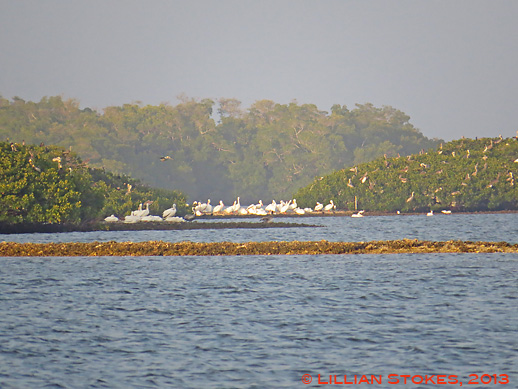
Then out to the rookery islands out in the bay where there were hundreds of birds, especially pelicans,

both White Pelicans,

and Brown Pelicans.


The birds were settling in for the night.

 The closer it got to sunset, the more birds flew in including may White Ibis, Snowy Egrets, other herons and more. The birds find safety at night on the islands and also a place to nest.

It was magical as the sun got lower.

and we had a spectacular sunset,

then moonrise. It was awesome being out in nature and experiencing the night ritual of the birds. Just us and them. Go if you can.

Green Heron Up Close and Personal


Green Herons are not your flamboyant sort. They prefer to skulk in cover then extend their long neck quickly to strike a fish. So when they decide to stand right out in the open in front of birders and photographers on wildlife drive in Ding Darling National Wildlife Refuge, Sanibel, FL, I consider it my  lucky day. 
Photos taken with the Canon SX 50 HS point and shoot super-zoom. Last photo is not cropped, it's zoomed in at 200x. 
The second photo is cropped, but untouched as to any kind of processing or sharpening, the rest of the photos have minimal done.

More Canon SX 50 Bird Photos

Yes, I am having fun with my camera, the new Canon SX 50 HS. Took it to Ding Darling National Wildlife Refuge yesterday and shot this Osprey hovering in "Sports Mode."

The camera does an amazing job on birds in flight.

Brown Pelican shot on "Smart Auto" mode.

Went to Blind Pass at sunset and took this Snowy Egret in "Sports Mode" fishing in the waves. 1/640 sec at f/5.6, 100 ISO, 100% digital zoom ratio. The camera does the thinking in these auto modes.

What is then fun is to be able to take the wide angle shot with the same camera and capture the beautiful sunset.

Canon SX 50 HS, 200x magnification ability at sunset

See the small heron in the bottom of the sunset photo with the shorebirds?

Well, just zoom out and magnify it 200% with the Canon SX 50 HS camera. It's a Roseate Spoonbill!

Just got the incredible Canon SX 50 HS. It actually has a 200x magnification ability. Wow. Went and photographed the sunset at Ding Darling National Wildlife Refuge. Look what it can do.
Can't wait to use it more!
The Canon SX 50 is a brand new point and shoot super-zoom camera that has a 50x zoom lens which is equivalent to a focal length of 24-1200mm. The optical zoom is 50x. The Digital Approx. 4x (with digital tele-converter approx. 1.5x or 2.0x and Safety Zoom). combined Approx. 200x

Birds in Flight Photography Tips


Osprey with fish. I use a Canon 1D Mark IV camera for most flight photos.

Pileated Woodpecker

Roseate Spoonbill

Bald Eagle, larger birds are easier to photograph in flight.

Groups of birds, such as these Black Skimmers, are fun to photograph in flight. When photographing them, increase your depth of field.

American Robin. Zero in on one bird in a flock.

Snow Bunting

Upland Sandpiper flying over Kennebunk Plains WMA, Maine

Tree Sparrow. Focus on your bird feeder and anticipate when a bird will leave.

Red-shouldered Hawk, juv.

Great Shearwater, a pelagic species you need to go out on a boat to see. It's challenging taking flight photos from a moving, rocking boat, so it helps to brace yourself against the boat.

Tree Swallow in flight over our fields. Swallows, with their erratic flight, are a challenge to photograph.

Cedar Waxwing. Pick up a bird when it is quite distant and track it with your camera's autofocus and start shooting as it gets a little closer. If you wait until it's upon you, you will never get the photo.

Roseate Spoonbill, coming in for a landing.


Peregrine Falcon taken with a Canon SX 40 HS point and shoot. I anticipated it leaving the branch.

My favorite type of bird photography is photographing birds in flight. Above are a few of my photos and here are some tips.

How do photographers get such photos? Here's what you need:

High speed digital SLR cameras like the Canon 7D, or 1D Mark IV (which I have). The faster, and the more continuous frames per second your camera will shoot, the better. Get a camera the shoots at least 5 frames per second, preferably more. Know your camera dials and settings very well. For most flight photos you need to have at least 1/500th of a second shutter speed, preferably 1/1000th or more. Set the ISO high enough to attain this shutter speed.
Set the camera on continuous shooting mode. Most people use auto focus for birds in flight. Set the camera focus mode to AI Servo AF (or the equivalent for other makes of camera). This allows you to focus and lock on the bird as it moves, by depressing the shutter half-way. Put the camera dial on AV (aperture priority) to give enough depth of field to have the whole birds in focus. Most people use an aperture of f/8 in good light, but may go to an aperature of f/5.6 in duller light. To take the photo, depress the shutter all the way.

- A good telephoto lens that is at least 300mm long, or preferably 400mm or more (some add a 1.4 teleconverter to a 300 mm lens.) Some photographers use longer lenses, such as the Canon 500mm or 600mm IS lenses for flight photos. If you have those, you need a good tripod with a smooth moving head, such as those made by Whimberly, Bogen or Kirk Enterprises. A few strong photographers can actually hand hold the 500mm lens. If you are using a tripod you lack some mobility, so it helps to shoot at a good location, such as that at Ding Darling NWR or other national wildlife refuges, where a lot of birds fly in, in a predictible flight route. Set the lens AF/MF switch to AF (auto focus.) Some recommend setting the minimum focusing distance of the lens to its furthest setting.

- Good situations for photographing birds in flight, such as open areas of water or open sky where you see birds coming from a distance and can get on them early with your auto focus, plus you will have a clear blue background. Keep the sun at your back. Try to shoot with the birds moving along a predictable flight path that is perpendicular to the front of your lens.

- Good eye-hand coordination and fast reflexes. Find the bird by spotting the bird when it is at a distance, and I mean very distant. Do not wait until the bird is close, because by then it will be moving too fast for your to get on it. After you spot it, raise your camera to your eye and lock the auto focus on the bird. In general most photographers set the camera's auto focus selection point (AF point) on the center point because it is the most sensitive of the points and allows you to keep focused on the bird. Also your camera will be less likely to lock onto the background as you try and stay on the moving bird.

- A willingness to practice lots and take lots and lots of photos, only some of which will turn out. (At least with digital you are not paying for film.)

- A strong motivation and desire to take flight photos.

- The expertise and programs to process your digital photo to make it look its best. Most photographers use programs like Adobe Photoshop.

Some people are now using superzoom point-and-shoot cameras, like the Canon SX 40 HS (which I own), to take bird photos. These cameras do well for birds that are relatively close, in good light and not moving fast. These cameras are harder to use on birds in flight for many reasons, such as they're slower to find and track birds. You can still get decent photos of birds in flight in some situations, such as photographing larger, slower moving birds in good light. So do try flight photos with these cameras.

Other photographers may have other tips or slightly different methods for flight photography, these are just the tips I generally use.

My advice is even if you don't have all or some of the above equipment, try flight photography anyway. You might find it addictive like I do.

Most importantly, have fun!!!
Lillian Stokes